Nature Recovery

The Nature Recovery Plan

Nature today has declined to the point where we don’t have enough of it. Not enough nature to support our amazing diversity of wildlife; but also, not enough nature to support the needs of people (Natural England 2020). This is the case even in our protected landscapes, including the Mendip Hills National Landscape.

Due to this ecological emergency – and the climate emergency – all National Landscapes across the country have committed to embarking on a programme of nature recovery by producing and delivering a Nature Recovery Plan in line with the Colchester Declaration 2019 and recommendations outlined in the Government’s Landscapes Review (Glover et al. 2019).

Since 2020, the Mendip Hills National Landscape Team has been working with a range of partners, consultants, local records centres, land managers, and specialists to get a better understanding of the state of nature in the National Landscape and, using this information, has developed a plan to help recover nature. After a final consultation period in April-May 2023, the first complete edition of the Nature Recovery Plan was published in August 2023.

The Plan will be updated over time in line with new data, resources, and guidance. It will be embedded into the next statutory National Landscape Management Plan and used to influence Local Nature Recovery Strategies.
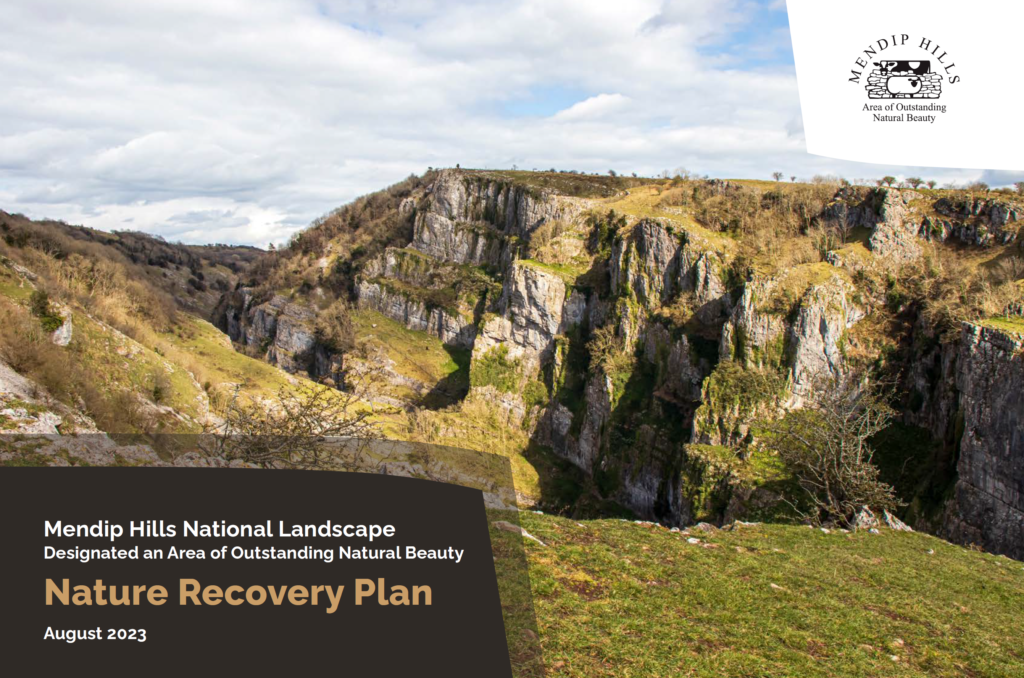
Click here or on the image below to view/download the Mendip Hills National Landscape Nature Recovery Plan (August 2023) [PDF Download 21MB]

The front cover of the Mendip Hills National Landscape Nature Recovery Plan


To bring this Plan to life, we’ve selected 8 Champion Species… let’s get to know them!

These are the Champion Species for the Mendip Hills National Landscape. We’ve made a film and factsheet on each, which you can see below.

What makes them ‘Champions’?

They’re all threatened and very vulnerable. They all tell us how good, or not, the environment is where they live. And, they’re all quirky, conversation-starters!

First, let’s give you a bird’s-eye view of how and why the Mendip Hills National Landscape is so special for wildlife with naturalist and broadcaster, Mike Dilger

Meet the Champions…


Adder

Is it a love/hate relationship?

What are your feelings on the Adder, one of the most iconic and talked about creatures on the Mendip Hills? Mike Dilger talks to John Dickson of the Reptile and Amphibian Group Somerset about this incredible animal.

Download the Adder factsheet here [1MB]…

Black Oil Beetle

You’ll learn to love the Black Oil Beetle. This lumbering, shiny black beetle lives a very strange life. Watch the film to find out more about this parasite, with some really rare footage! Mike Dilger learns all about this Champion Species from Nathan Orr, Nature Recovery Ranger for the Mendip Hills National Landscape Team.

Black Oil Beetles emerge in February/March and if you come across one you know you’re on really good grassland that’s rich in flowers. You’re also likely to be in or near the Mendip National Nature Reserve along the south-facing slopes of Mendip.

Download the Black Oil Beetle factsheet here [1.5MB]…

Cheddar Pink

It’s the Flower of Somerset!

This small rose-pink carnation loves to grow on steep, rocky outcrops on Mendip. The small flowers smell strongly of cloves, and come out in from May to July.

The stronghold of the Cheddar Pink in the UK is Cheddar Gorge, but they can be found in smaller numbers along the south-facing slopes of the Mendip Hills. These plants are limestone specialists, clinging to cliff faces in hard to reach spots, in environments where nutrients are scarce and the conditions can be harsh, they certainly deserve the title of ‘hardy perennial’.

Download the Cheddar Pink factsheet here [1.4MB]…

Greater Horseshoe Bat

Out of all the Champion Species films this was the most technically difficult to film. This one really is special. Let’s go underground to meet the Greater Horseshoe Bat.

One of the largest bats in the UK, they spend the winter in the Mendip caves, and they ‘hum’ through their amazing horseshoe shaped nose.

When you watch the footage bear in mind that not one ion of light was bouncing around in the cave, it was all filmed in complete darkness using special cameras under the Mendip Hills, something that’s never been done before. The Mendip National Nature Reserve is where most of the Greater Horseshoe Bat roosts are and where they feed.

Download the Greater Horseshoe Bat factsheet here [800KB]…

Hazel Dormouse

Is it the cutest of our Champion Species? The Hazel Dormouse has a very high ‘cute’ factor with its furry tail and large black eyes. Share this one with your friends as everyone needs a cute little dormouse in their life.

Although it’s called the Hazel Dormouse, it eats a wide variety of flowers, leaf buds, insects and hedgerow fruits like hawthorn berries. It fattens up on hazel nuts in the autumn. You can tell if a hazel nut has been eaten by a dormouse as the hole it leaves in the shell is a perfect little circle. They love a good scrubby woodland, with lots of undergrowth and big, bountiful hedges.

Download the Hazel Dormouse factsheet here [1.4MB]…

Skylark

Stephen Moss, birder, author and President of Somerset Wildlife Trust, sings their praises with Mike Dilger. With a perky little tuft on its head, it darts up in a straight line into the air singing its heart out. But the Skylark needs extra care from all of us as it nests on the ground in the long grass so it can easily be frightened by dogs.

Small Pearl-bordered Fritillary

A butterfly with pearls on its wings. Well, white patches called ‘pearls’ on the back of its wing. Watch out for this beauty in June when you can see the vivid orange wings as it flies low across the ground.

The Small Pearl-bordered Fritillary has declined drastically across the country so if you do see one you know you’re on well-grazed grassland or heathland that has a great mix of plants, including the common dog violet.

Download the Small Pearl-bordered Fritillary factsheet here [1.6MB]…

Water Vole

Welcome to the world of the Water Vole, one of Britain’s most endearing and endangered mammals. This film takes us down onto the lower lying land and the Levels surrounding the Mendip Hills where Mike Dilger and Tim Haselden from the Mendip Hills National Landscape Team dive into the watery challenges these creatures face.

From habitat loss to predation, learn about the issues and the conservation efforts needed to ensure the survival of this charismatic species, affectionately known as ‘Ratty’ from ‘The Wind in the Willows’.

Looking to plant trees in the National Landscape?

We’ve produced a simple Tree Planting Guide for the Mendip Hills that landowners can use if they wish to plant trees or create new woodlands in the area.

Planting the ‘right tree in the right place’ is very important, especially in a sensitive landscape such as the Mendip Hills, in order to make sure we don’t destroy other habitats that are rich in wildlife, areas of high archaeological value, or the character of the area.